You're Rejecting Yourself Before She Gets the Chance

Updated: Apr 12
When I was 16, my high school crush pulled me aside at a New Year's party and said, "There's something I've been wanting to do."
Then she leaned in to kiss me.
I dodged her like she was throwing a punch and ran out of the party.
I genuinely thought she was pranking me. The idea that she actually wanted to kiss me didn't even enter my mind. So I rejected myself on her behalf before she had the chance to do anything.
She wasn't rejecting me. I was rejecting me.
I've told that story to a lot of men over the years, and almost every single one of them laughs in recognition. Not because they did the exact same thing, but because they've got their own version of it. The girl they never asked out. The number they never texted. The move they never made. The moment they talked themselves out of before anyone else got a vote.
Most men think their dating problems are about rejection. They're not. They're about self-rejection — the quiet, constant habit of deciding the answer is no before the question is even asked.
The Stories We Tell Ourselves
Here's how it works in practice.
You see a girl you're attracted to. Before you've said a word, your brain starts running through reasons it won't work. She probably has a boyfriend. She's out of your league. She looks like she's in a hurry. This isn't the right moment. You'll catch the next one.
And then she's gone.
What just happened wasn't rejection. Nobody rejected you. You walked up to a jury, heard the verdict in your head, and left before the trial started.

The brutal truth is that most men who struggle with women aren't struggling because women don't like them. They're struggling because they've decided women don't like them — and that decision shows up in every interaction before a single word is exchanged. It's in the eye contact that breaks too soon. The voice that goes up at the end of sentences. The joke that gets swallowed before it leaves the mouth. The approach that never happens.
Your internal belief about how this is going to go becomes the thing that makes it go that way. Psychologists call this a self-fulfilling prophecy. I call it losing a game you never played.
The Interpretation Problem
Part of what makes self-rejection so insidious is that we're constantly finding evidence to support it.
A girl makes eye contact and looks away. You tell yourself she thought you were creepy. Another possibility — one that's just as plausible — is that she looked away because she was attracted to you and felt nervous. You have no way to know which is true. But you picked the interpretation that kept you from taking action.
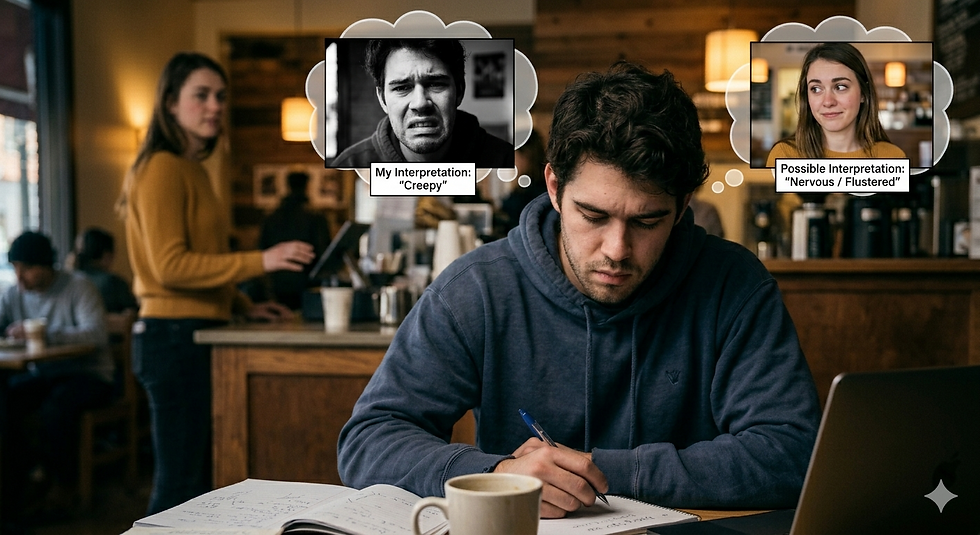
A girl gives you a short answer when you approach. You decide she's not interested and eject. Maybe she was caught off guard. Maybe she was having a bad day. Maybe she needed thirty more seconds to warm up. You'll never know because you left.
This isn't me telling you that every girl who rejected you was secretly into you. That's not true and it wouldn't help you even if it were. The point is that you're constantly making interpretive choices — and most men default to the interpretation that confirms their worst beliefs about themselves and gives them permission to do nothing.
The man who defaults to positive interpretations isn't delusional. He's just playing the odds differently. And he ends up taking more action, which means more real data, which over time actually changes what he believes about himself.
What Actually Breaks the Pattern

When I finally started approaching women — not thinking about it, not studying it, actually doing it — the thing that surprised me most wasn't the rejections. It was how often the voice in my head was completely wrong.
Girls I was convinced would blow me off didn't. Girls I thought were out of my league were interested. Approaches I was certain would be awkward turned into real conversations. The story my brain had been telling me about how this would go was wrong often enough that I couldn't keep believing it automatically.
That's the only thing that actually changes self-rejection. Not affirmations. Not mindset work in a vacuum. Not another article about confidence. Real interactions, with real women, that give your brain real evidence to work with.
Every time you approach and come out the other side intact — even if she wasn't interested, even if it was awkward — you're building a case against the story that said you couldn't do it. Do that enough times and the story starts to fall apart.
The approach anxiety doesn't disappear. But it stops being in charge.
The Question Worth Asking
Think about the last time you saw a woman you were attracted to and didn't do anything about it.
What stopped you?
If the honest answer is that you already knew she wouldn't be interested — that's self-rejection. She didn't make that decision. You did. And you made it without any evidence, based entirely on a story you've been telling yourself long enough that it feels like fact.
The good news is that stories can change. But they don't change from the inside out — they change from the outside in. You don't think your way to confidence. You act your way there, one uncomfortable approach at a time, until the evidence outweighs the story.
She didn't reject you.
You rejected you.
And that's actually good news — because you're the one variable in this equation you can control.


Comments